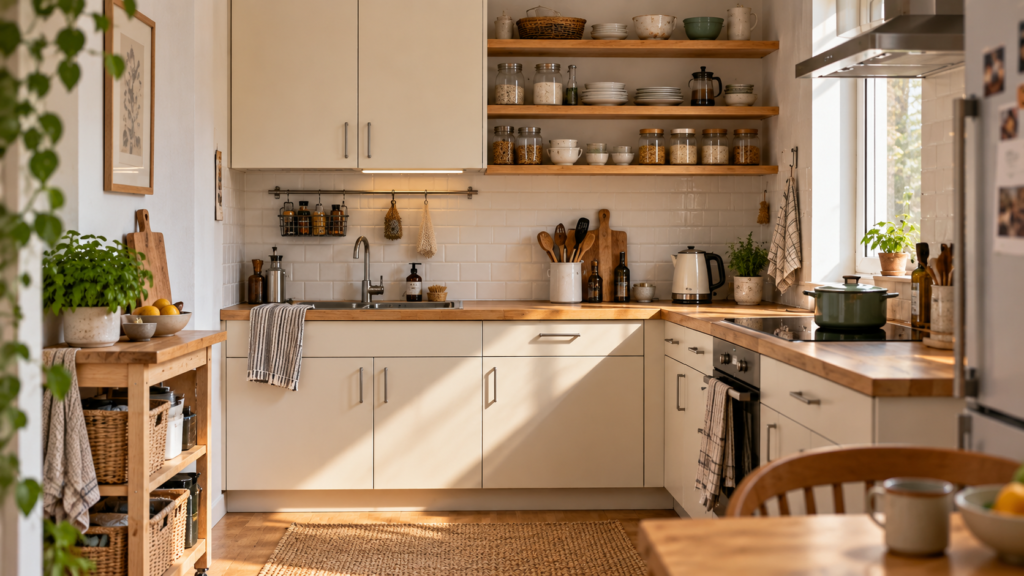
Organize your kitchen one zone at a time, with practical storage ideas for cabinets, pantry space, drawers, and more. Start with what makes everyday tasks awkward, then choose solutions that fit both the space available and the way you cook.
This post contains affiliate links. As an Amazon Associate I earn from qualifying purchases.
Editorial review by Nookwise Living. Last reviewed September 8, 2026
Jump to a kitchen zone
Start with no-cost and affordable kitchen storage
More organizers do not automatically make a kitchen easier to use. Try these steps before adding anything new:
- Choose one daily frustration, such as digging for a pan or moving groceries to reach breakfast supplies.
- Empty that area and remove what does not belong. Set aside duplicates and items you no longer use.
- Put frequently used items within easy reach and less-used items farther back or on higher shelves.
- Try bins or baskets you already own, or adjust an existing shelf if possible.
- If a problem remains, measure the space and consider buying only for that specific need.
Make kitchen cabinets easier to use
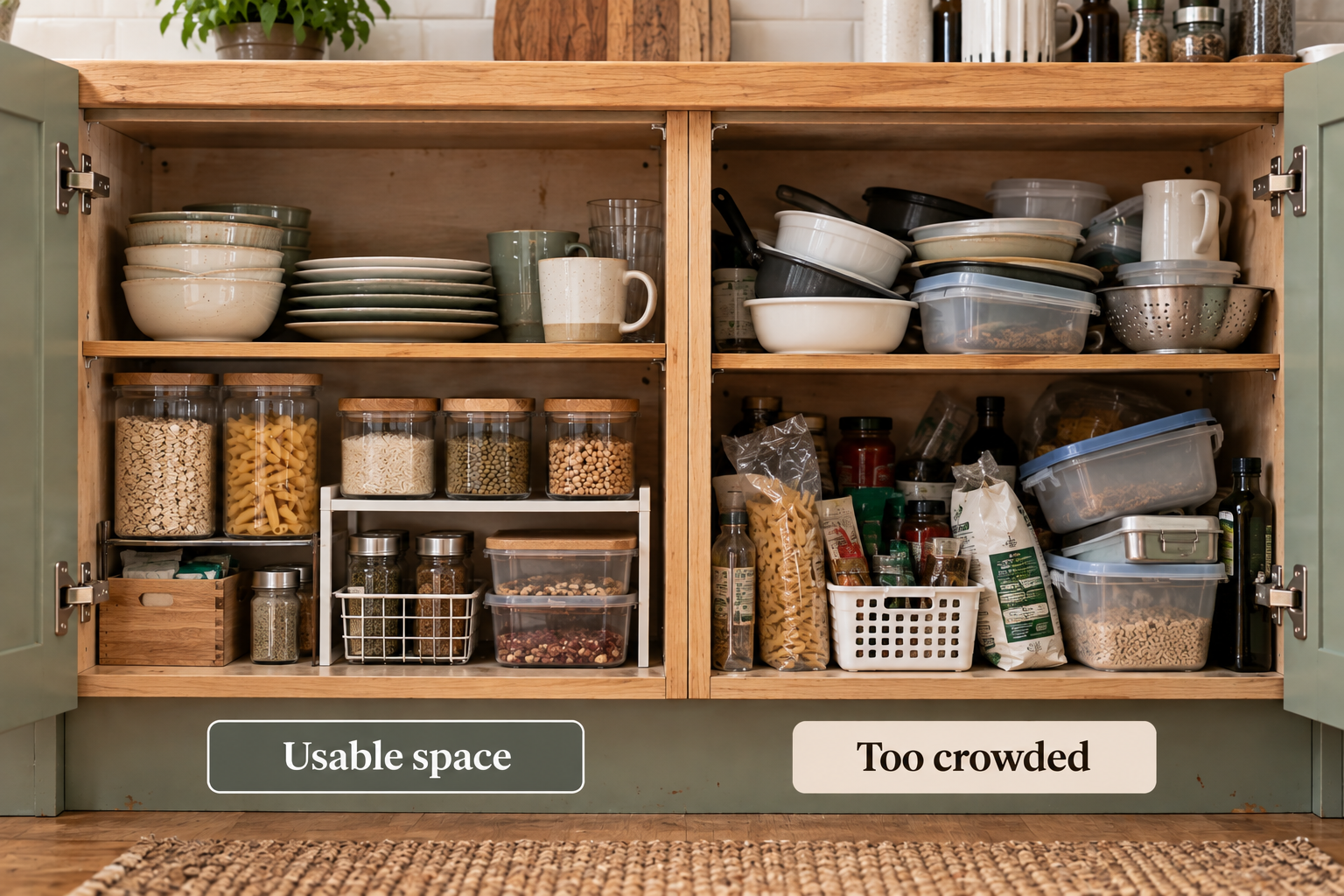
Give each shelf a clear purpose, keep everyday items easy to reach, and avoid tall stacks that are awkward to lift or put back. Notice whether the problem is unused height above your dishes or depth that leaves small items hidden at the back: each needs a different approach.
Shelf riser
A shelf riser can help when there is unused vertical space above the items already on a shelf. It is useful only if it creates two levels you can comfortably use.
Check first: Measure the shelf’s inside width and depth, along with the available height. Allow enough room above and below the riser to take items out and put them back. Check where its legs will sit and any stated weight limit.
Skip the riser if it leaves dishes wedged into place or makes everyday items harder to reach. A freestanding model needs no fixed mounting. If you have room for two usable levels, see the shelf riser options.
Removable bin for deep shelves
A removable bin can keep small pantry items from disappearing at the back of a deep cabinet. Pulling them forward as a group may make them easier to find and return.
Check first: Measure the narrowest part of the cabinet opening, account for hinges, and check the usable shelf depth. Make sure you can comfortably pull out and lift the bin when it is full.
A bin is less helpful if it becomes too heavy to handle or its shape leaves too much shelf space unused. Use a size you can manage without rearranging everything around it. No fixed mounting is needed.
Create pantry storage in a small kitchen
Keep similar foods together so you can see what you already have and return groceries to a familiar spot. Useful pantry storage keeps everyday ingredients visible and reachable.
No separate pantry? Start by choosing one existing cabinet or shelf as your main food-storage zone. Group supplies there before deciding whether you need extra space.
Removable bins for pantry groups
Bins can help when small packages spread across a shelf or disappear behind one another. Use them for groups you regularly reach for together, such as baking supplies or snacks.
Check first: Check shelf depth, the cabinet opening, and the height of your packages. If you plan to stack bins, make sure you can still reach what you use every day.
Stacking is optional. If getting one item means removing several bins each time, keep those groups side by side or leave everyday items unstacked. Freestanding bins need no installation. Once you know the space and access you need, see the pantry bin options.
Rolling cart as extra pantry storage
A rolling cart may provide extra food storage when your existing pantry storage is too limited and you have a practical place to park it. It is an optional addition, not something every kitchen without a pantry needs.
Check first: Measure the cart’s full outside dimensions, including handles or other projecting parts, and check shelf heights. Make sure you can reach its contents, open nearby cabinet and appliance doors, and move through the kitchen normally.
If the cart must be moved every time someone passes through, it is unlikely to make the kitchen easier to use. A freestanding cart needs no fixed mounting, but it still needs a suitable parking spot. If you have one, see the rolling kitchen cart options.
Organize small kitchen drawers
Give cutlery and cooking utensils clear places without filling every gap with an organizer. Keep shallow drawers arranged in a single layer where possible, and choose compartments that fit what you own.
Drawer dividers for long utensils
Dividers can help keep spatulas, whisks, and serving spoons from sliding into one mixed pile. Leave enough width for broader utensils so they are easy to take out and return.
Check first: Measure the drawer’s inside width and depth, the divider height, and the clearance above your utensils so the drawer closes normally. Check that the attachment mechanism suits the drawer. For a removable setup, choose an option that does not require drilling or risk damaging the surface.
Skip dividers if their walls take up too much usable space or leave awkwardly shaped tools squeezed into narrow compartments. If separate sections would help, see the drawer divider options.
Small containers you already own
Use a few small containers to keep bag clips, measuring spoons, or other loose items from disappearing among larger utensils. Start with containers you already have and arrange them around the longer tools.
Check first: Make sure the containers are low enough for the drawer to close with their contents inside. Leave sufficient uninterrupted space for longer items.
If several little containers create more gaps and edges than useful storage, use fewer of them. The aim is to make small items easy to find while keeping the rest of the drawer usable.
Organize kitchen storage under the sink
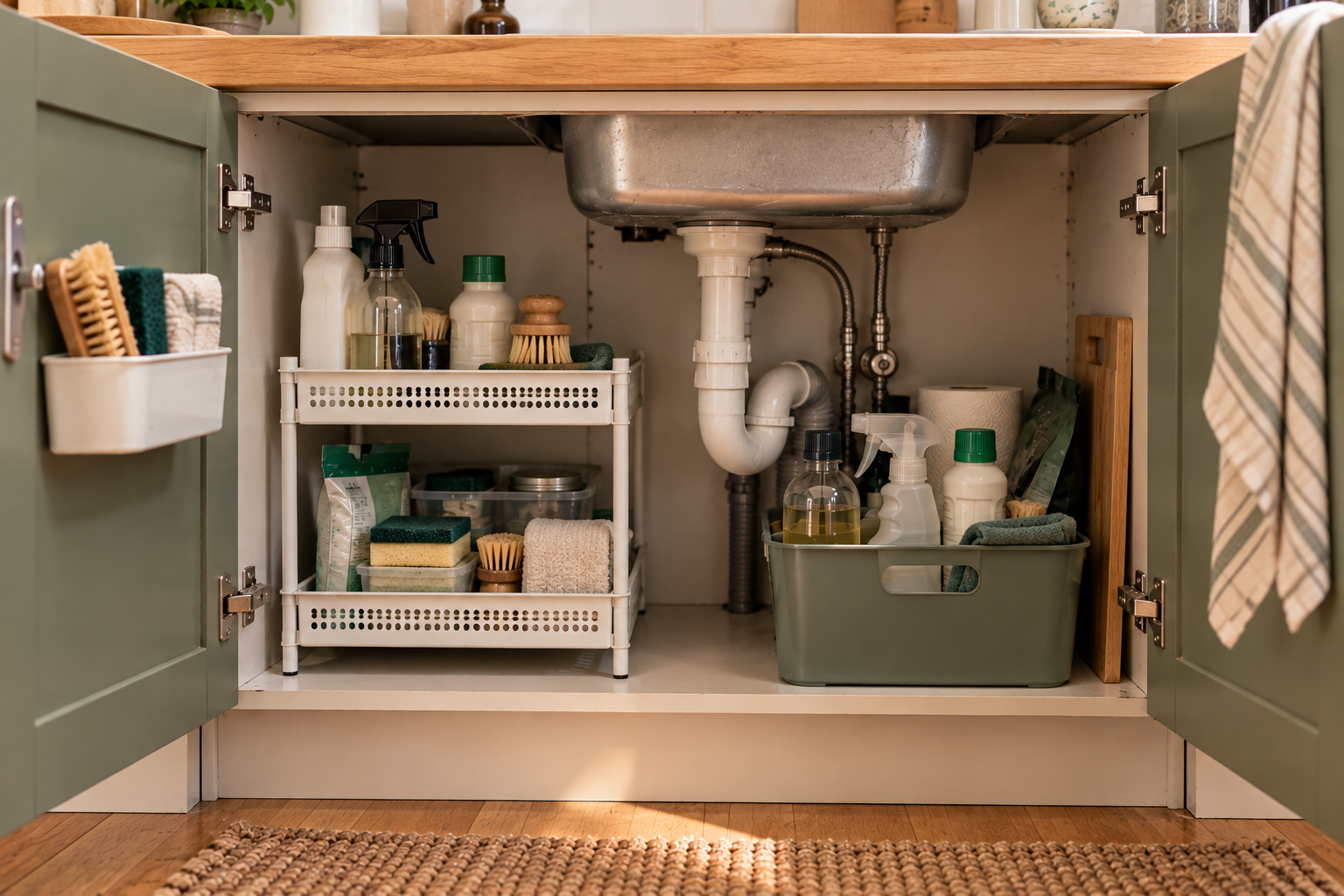
Measure the space around the plumbing before deciding how to use it. Keep everyday cleaning supplies together and keep reserve stock separate, while leaving pipes and connections accessible.
Organizer that fits around the plumbing
An organizer may help when there is a usable area beside or around the pipes. Look at the shape of that free space, rather than relying on the cabinet’s overall dimensions.
Check first: Measure the available width, depth, and height, accounting for pipes, hinges, and other projecting parts. Check bottle heights and the cabinet opening, including the route needed to put the organizer inside. If it has a sliding section, allow room for its full movement.
An organizer is a poor fit if it catches on plumbing, cannot pass through the opening, or blocks access to connections. A freestanding model may avoid drilling, but installation requirements vary. Use these measurements when considering under-sink organizers.
Removable caddy or bin
A caddy or bin can work where plumbing leaves an irregular space or when you often use several cleaning supplies together. Try a suitable container you already own before buying another.
Check first: Make sure it passes through the cabinet opening and has enough clearance above any handle. Check that you can comfortably lift it out when full without catching nearby pipes.
Keep the load manageable and tall bottles upright. If the container becomes awkward to lift or its contents tip easily, reduce what you keep in it or use a better-fitting container. No mounting is needed.
Keep kitchen countertops clear for cooking
Keep everyday essentials together and store less-used appliances elsewhere when practical. Grouping items may make a counter look tidier, but it only helps with cooking if enough usable work surface remains.
One compact daily-use zone
If daily essentials spread across the counter, give them one defined spot. An existing tray can help mark that area, but a clear place for each item may be enough.
Check first: Leave room for the way you prepare food and wipe down the counter. Make sure nearby cabinets and appliances remain easy to open and reach.
Keep the zone small enough that it does not take over your remaining prep space. If a tray adds bulk without making items easier to manage, leave it out.
Compact countertop shelf
A shelf may help where one defined area has unused height and you can still keep enough usable counter space clear. It should make the items in that spot easier to reach.
Check first: Measure the shelf’s footprint and total height, along with the space between levels. Check that outlets remain accessible and overhead cabinet doors can open fully.
Skip the shelf if it crowds your prep area or simply encourages more things to stay on the counter. A freestanding model needs no fixed mounting. If the space works, consider the countertop shelf options.
Find practical storage for small appliances
A daily-use appliance may earn a place on the counter, while one used occasionally can be stored elsewhere. Frequency is only part of the decision: size, weight, and how easily you can take it out and put it back matter just as much.
Reorganize an existing cabinet or shelf
An existing cabinet or shelf can be a useful home for an appliance if you can reach it without awkward lifting or moving several other items first. Lighter appliances may be easier to place higher up, provided you can still lift them comfortably.
Check first: Measure the appliance’s full dimensions, including handles, and allow space for any separate parts. Check the cabinet opening, available height, and the shelf’s weight capacity.
Avoid a spot that requires a heavy lift from overhead or an awkward reach each time. Rearranging existing storage needs no new installation, but the appliance still needs to be manageable in that location.
Rolling cart as appliance storage
A cart may offer an extra place to store an appliance when there is a permanent parking spot and the appliance is easy to lift on and off. Treat it as storage when planning the space.
Check first: Check shelf dimensions, the manufacturer’s stated weight limits, stability, and the wheels, including how the cart stays in place while you load or unload it. Account for projecting handles or appliance parts, and leave enough parking and walkway space.
Avoid the setup if the appliance overhangs the shelf, makes the cart unstable, or blocks normal movement through the kitchen. A freestanding cart requires no fixed installation. Being suitable for storage does not establish that an appliance can be operated on it; that depends on the instructions for both the appliance and the cart.
If you have a suitable spot, see the rolling kitchen cart options.
Choose organizers that fit your kitchen
These practical categories can help you find the type of organizer discussed above. Products have not been personally tested or ranked. Check dimensions and product specifications against your space and intended use before buying.
Cabinet shelf risers
Good for: Turning unused cabinet height into two usable storage levels.
Check first: Leave enough usable space both below and above the riser.
Stackable pantry bins
Good for: Keeping small pantry items together and easier to reach.
Check first: Everyday items should remain accessible if you stack the bins.
Drawer dividers
Good for: Keeping long cooking utensils in separate, easy-to-find sections.
Check first: Check the drawer’s inside dimensions and make sure it can close normally.
Under sink organizers
Good for: Organizing usable space around plumbing.
Check first: The organizer must fit through the cabinet opening and leave pipes and connections accessible.
Countertop shelves
Good for: Adding vertical storage within one defined counter area.
Check first: Leave enough clear work surface for everyday food preparation.
Rolling kitchen carts
Good for: Adding pantry or appliance storage where you have a dedicated parking spot.
Check first: The cart should fit without blocking walkways or cabinet and appliance doors.
Small Kitchen Storage FAQ
Start with the storage problem that frustrates you most and see whether one change makes daily tasks easier. You do not need to organize the whole kitchen at once. For ideas beyond the kitchen, continue with Small Apartment Organization Ideas.